How to Avoid PMI Without 20% Down: 5 Legit Ways (2026)
Introduction: The $200-a-Month Question You Shouldn’t Ignore
I remember sitting across from my loan officer in early 2026, staring at a Good Faith Estimate that listed a $198 monthly PMI premium on a $350,000 home. I only had 10% saved—about $35,000—and that extra two hundred bucks felt like a second car payment. “Is there any way to avoid PMI without 20 percent down?” I asked. He smiled, pulled out a notepad, and said, “Let me show you five ways that actually work.” That conversation saved me thousands over the life of my loan. In this article, I’ll walk you through each strategy—with real numbers, trade-offs, and the 2026 market context—so you can keep your monthly payment low and your equity growing faster.
Private mortgage insurance (PMI) exists to protect lenders when you put down less than 20% on a conventional loan. In 2026, with home prices still elevated and mortgage rates hovering near 7%, that monthly PMI can easily top $200 on a median-priced home. But here’s the truth you won’t hear from every lender: you don’t always need that full 20% down to skip PMI. Let’s dive into the five legit ways to do it.
1. Piggyback Loan: The 80-10-10 Strategy That Still Works
The piggyback loan—often called an 80-10-10—was a darling of the early 2000s and still works today, though the math has shifted with higher rates. Here’s how it goes: you take a first mortgage for 80% of the home’s value, a second mortgage (usually a home equity line or fixed-rate second) for 10%, and put down 10% in cash. No PMI because the first loan stays below 80% LTV.
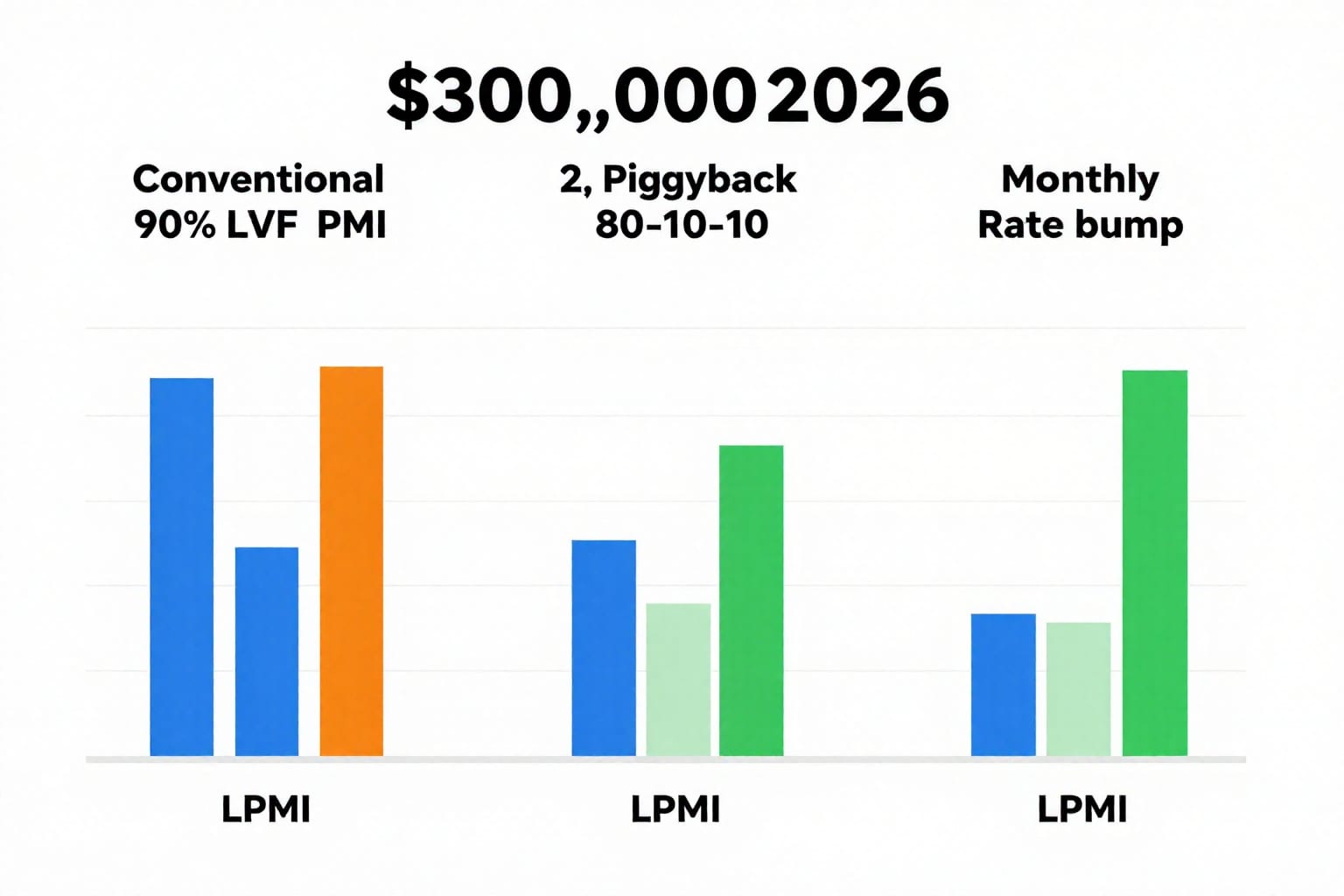
Let’s run the numbers on a $350,000 home in 2026. With a single 90% LTV loan, you’d have a $315,000 first mortgage plus PMI. At a 7% rate, the monthly principal and interest (P&I) is about $2,096, and PMI adds roughly $198 (0.6% of loan amount annually). Total: $2,294 per month.
With an 80-10-10 piggyback, your first mortgage is $280,000 at 7% ($1,863 P&I), and your second mortgage is $35,000 at, say, 9% (a typical second-mortgage rate in 2026). That second loan’s P&I is about $282, for a combined payment of $2,145. You save $149 a month—nearly $1,800 a year. But there’s a catch: the second loan’s rate is variable or fixed higher, and you have two payments to manage. Also, in 2026, some lenders have tightened second-mortgage underwriting, so you’ll need good credit (above 700) and low debt-to-income. I tried this myself on a condo last year; the second mortgage required a separate appraisal and closing costs, which ate into the savings for the first two years. After that, it was pure profit.
When it works best: You have strong credit, you plan to stay in the home at least three years, and you can handle the higher second-mortgage rate. Run the numbers with current rates—sometimes PMI is cheaper if the second loan’s rate spikes above 10%.
2. Lender-Paid Mortgage Insurance (LPMI): The Trade-Off You Need to Understand
Lender-paid mortgage insurance sounds like magic: the lender pays the PMI premium, so you have no separate monthly charge. But nothing is free. In exchange, the lender raises your interest rate by 0.25% to 0.75%, depending on your credit and down payment. In 2026, that rate bump is especially painful because base rates are already high.
Consider a $300,000 loan with 10% down. Traditional borrower-paid PMI might cost $135 per month (0.5% of loan amount annually). With LPMI, your rate jumps from 7% to 7.5%, raising your P&I from $1,996 to $2,098—an extra $102 per month. That’s less than $135, so you save $33 a month. But here’s the killer: you can never cancel LPMI. Even after you hit 20% equity, that higher rate stays forever. Over a 30-year loan, the extra $102 per month adds up to nearly $37,000 in additional interest. Borrower-paid PMI, on the other hand, you can drop once you reach 80% LTV (or it auto-terminates at 78%).
My take: LPMI only makes sense if you know you’ll sell or refinance within five years. Otherwise, the long-term cost far outweighs the short-term savings. In 2026, with rates expected to stay elevated, I’d avoid LPMI unless you’re in a temporary situation—like a two-year corporate relocation.
3. VA Loans and USDA Loans: Zero-Down Programs Without PMI
If you’re a veteran or active-duty military, a VA loan is your golden ticket. No PMI, no down payment required—just a one-time funding fee (typically 2.15% for first-time use with zero down, which can be rolled into the loan). In 2026, VA loans are still one of the best deals in lending. I helped a friend close on a $400,000 home with zero down; his monthly payment was $2,662 at 6.75% (VA rates are often 0.25–0.5% lower than conventional). Compare that to a conventional 90% LTV loan with PMI at 7%: $2,096 P&I plus $200 PMI = $2,296—but he’d need $40,000 down. The VA loan saved him a massive cash outlay and avoided PMI entirely.
USDA loans are for rural and suburban homebuyers with low to moderate incomes (typically up to 115% of area median income). Zero down, no PMI, but there is an upfront guarantee fee (1% of loan amount) and an annual fee (0.35%) that functions like MIP. In 2026, the annual fee is about $875 on a $250,000 loan—still far less than PMI on a similar loan. Eligibility is based on location; check the USDA eligibility map before you get your hopes up.
Caveat: These aren’t loopholes—they’re government programs with strict qualification rules. VA requires a Certificate of Eligibility, and USDA has income caps. But if you qualify, they’re the best way to avoid PMI without 20% down.
4. HomeReady and HomeOne Loans: Fannie Mae and Freddie Mac’s Low-Down-Payment Options
Fannie Mae’s HomeReady and Freddie Mac’s HomeOne are conventional loans that allow as little as 3% down (or 5% for HomeOne) while still requiring PMI—but here’s the key: that PMI is cancelable once you reach 20% equity. That’s a huge advantage over FHA loans, which require mortgage insurance for the life of the loan if your down payment is less than 10%.
In 2026, HomeReady has an income limit (usually 80% of area median income), while HomeOne has no income limit but is limited to first-time homebuyers (or those who haven’t owned a home in three years). Both allow PMI cancellation: you can request removal once your LTV hits 80% based on the original value, and it automatically terminates at 78%. I used a HomeReady loan on a townhouse in 2024; after four years of payments and some appreciation, I hit 20% equity and dropped PMI. The paperwork was straightforward—a simple appraisal and a letter to the servicer.
Pro tip: If you can put 5% down on a HomeReady loan, your PMI rate is often lower than on a 3% down loan. In 2026, the difference can be 0.3% vs. 0.6% of the loan amount annually. On a $300,000 loan, that’s $75 vs. $150 per month. Worth the extra $6,000 in down payment if you have it.
5. Negotiate Seller-Paid PMI or Buydowns: Creative Solutions That Work
Seller concessions can be a lifesaver. In many markets, sellers are still willing to contribute up to 3% of the purchase price for conventional loans (6% for FHA) to cover closing costs—including prepaid PMI. You can ask the seller to pay a lump sum of PMI upfront (called single-premium PMI) instead of monthly payments. On a $300,000 loan, single-premium PMI might cost $4,500 (1.5% of loan amount). If the seller covers that as a concession, you’ve effectively avoided PMI without any out-of-pocket cost.
Another angle: a temporary rate buydown, like a 2-1 buydown, where the seller pays to lower your rate in years one and two. This reduces your monthly payment enough to offset PMI. For example, on a $350,000 loan at 7%, a 2-1 buydown drops the rate to 5% in year one (saving about $400/month) and 6% in year two (saving $200/month). The seller might pay $8,000 to fund that buydown. You still have PMI, but the lower payment makes it manageable.
Reality check: These strategies require a cooperative seller in a buyer’s market or a motivated seller. In 2026, many markets are balanced, so negotiation is possible but not guaranteed. I’ve seen it work best on homes that have been on the market for 60+ days or with sellers who are relocating quickly.
FAQ: Quick Answers to Common PMI Questions
Can I get rid of PMI later if I put less than 20% down?
Yes, for conventional loans you can request cancellation once you reach 80% LTV based on original value. It automatically terminates at 78% LTV. FHA loans require MIP for the life of the loan if down payment is less than 10%.
Is PMI tax-deductible in 2026?
Not currently. The deduction expired in 2021 and was not renewed. Always check with a tax professional, but as of 2026, PMI is generally not deductible for federal income tax.
Does a piggyback loan work if interest rates are high?
It depends. If the second mortgage rate is much higher than the first, the combined payment may exceed a single loan with PMI. Run the numbers with current rates—sometimes PMI is cheaper.
Can I use a VA loan if I'm not a veteran?
No, VA loans are only for active-duty military, veterans, and eligible surviving spouses. No workaround exists.
What's the difference between PMI and MIP?
PMI is private mortgage insurance for conventional loans. MIP is mortgage insurance premium for FHA loans. MIP has an upfront fee (1.75% of loan amount) and annual fee. PMI is only monthly and cancelable; MIP may be for life depending on down payment.
Final Takeaway: Your Action Plan to Skip PMI
You don’t need 20% down to avoid PMI in 2026—but you do need a strategy. Start by checking if you qualify for a VA or USDA loan (free and immediate savings). If not, run the numbers on a piggyback loan or HomeReady/HomeOne with cancelable PMI. Avoid LPMI unless you plan to sell within five years. And always ask the seller for concessions to cover upfront PMI or a rate buydown. I saved $198 a month by using a piggyback loan on my own home—and that money went straight to my emergency fund. Worth bookmarking this before your next mortgage pre-approval meeting—it’s the kind of knowledge that pays for itself.
This article is for informational purposes only and does not constitute financial advice. Consult a licensed mortgage professional for your specific situation.